

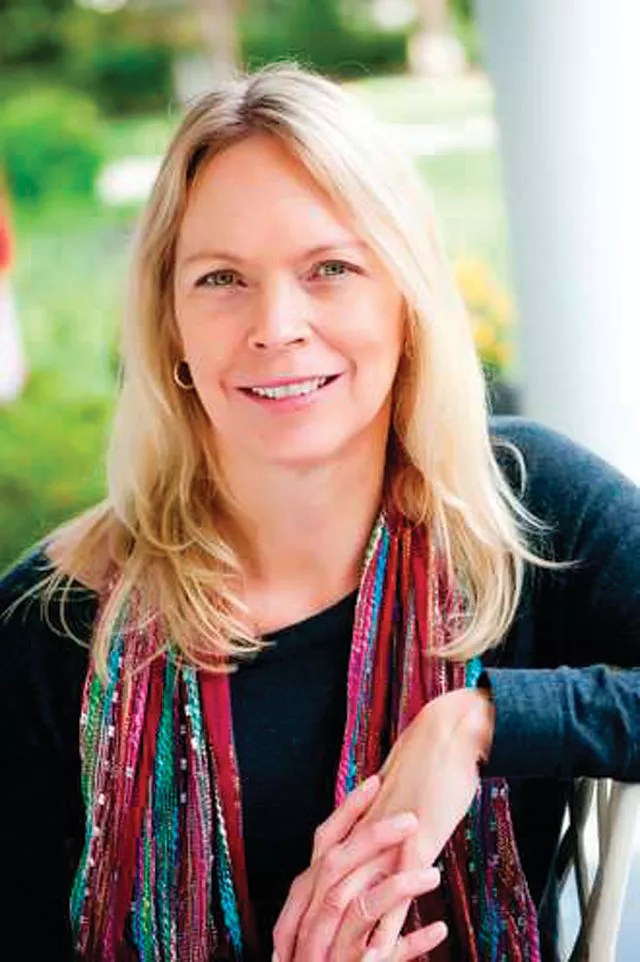
For decades, Rocky Flats, Colorado, was one of the nation’s centers of nuclear bomb production. Here Cold War warriors molded plutonium triggers with lead-lined gloves for a rapidly expanding atomic arsenal. It was by nature a facility shrouded in secrecy. In the town that grew up around the Dow Chemical-operated plant, few but the employees themselves knew what was being produced. Cleaning supplies, perhaps? Until a joint FBI-EPA raid on the plant, no one could have suspected just how much highly toxic pollution had vented into the surrounding countryside or how close Colorado had come to an accidental nuclear explosion. Writer (and former Rocky Flats employee) Kristin Iversen grew up within eyeshot of Rocky Flats’ water tower and comes to San Antonio this week to speak of her personal experiences as a resident and worker there as well as share broader lessons learned in the decade she spent researching Full Body Burden: Growing Up in the Nuclear Shadow of Rocky Flats.
San Antonio was leading the charge in the recently trumpeted “nuclear renaissance” before serious cost increases and corporate in-fighting collapsed the deal. Of course, that was followed by the multiple meltdowns at Fukushima. And yet our publicly owned utility remains open to nuclear expansion in the future. In your opinion, is there a legitimate argument for keeping the nuclear door open as an energy source?
I think there’s so many unsolved problems and risks and things that people aren’t talking about. It’s very interesting to be in touch with people in Japan and hear how the conversation and protests are developing there. I think they’ve been forced to face these issues much more directly than we have in the States. I think it is disturbing to me the way we’re sort of pushing ahead with the nuclear power plants. There are so many issues in respect to safety, and then my particular thing is truth and transparency and putting the environment at risk in ways people are not aware. Certainly the human cost to people who live near to these facilities, and how their lives and health and properties may be affected in a very direct way, that’s what worries me. One interesting thing that has happened since this book came out, I’ve received literally hundreds of emails from people who live around Rocky Flats, but also the Hanford [long-time nuclear production site in Washington] and Savannah River [nuclear reservation in South Carolina], and they send me these poignant emails about how they feel their health and their families’ health have been affected by these plants in a negative way. A lot, a lot, a lot of cancer stories. A lot of scary stories.
Certainly if you look at some of the epidemiological studies that have been done in Germany, for instance, they’re very, very different than what we’ve seen in the States.
There’s never been any public health monitoring at Rocky Flats. In lots of studies, an independent study will show high levels of cancer and the Department of Energy will come back and say ‘Well, you know, it’s all relative. It’s not really that much worse than anywhere else.’ And these studies go back and forth. But the frustrating thing for me … it’s not anything that has really been discussed. It’s not stories that have been told. There’s no information or support for [the affected families].
What was Rocky Flats for you before you worked there and after you had been there? And how did other people in the community see it?
Rocky Flats was sort of the big secret of my childhood. We could see the water tower from our back porch, that’s how close we were. We never really knew what they did. People in the neighborhood — it was operated by Dow Chemicals — they thought they were making cleaning supplies. My mother thought they were making scrubbing bubbles. To the day she died she wasn’t completely convinced. We were riding our horses out there and swimming in the lake. It’s very difficult to think the environment is contaminated. It took me a long time to really see what was happening in Rocky Flats. One day after I came home from work, put the kids to bed, and made myself a cup of tea, and there was a Nightline expose on Rocky Flats. The mantra of the plant was “everything’s fine,” and here they’re saying on Nightline that there are 14 tons of plutonium unsafely stored at the plant, and leaks into the environment, and problems with workers, and I was stunned. I grew up in a very conservative environment, and it took me a long time to shake the idea that the government and these private corporations would tell us if something was wrong, would tell us if they were putting our lives and our health at risk. … It took me a long time to sort of come to grips with that and see what was really going on.
What were the circumstances that led the raid on Rocky Flats?
There had been rumors about Rocky Flats for many years, and Jon Lipsky with the FBI and William Smith with the EPA started to investigate this. Then they started getting calls from workers inside the plant who were concerned. Jim Stone, who worked at the plant for a number of years, said at the beginning “You are putting this plant in the wrong location” [because of wind patterns that transported potential airborne radioactive pollution to the population center of Denver]. There was very strong indications that there was heavy and extensive radioactive and toxin contamination at the plant and the plant was operating in violation of environmental law. That led to the raid on June 6, 1989, and … that raid led to a two-year grand jury investigation that was eventually scuttled. It also led to a class-action lawsuit on the part of more than 13,000 local residents. That case took 20 years to wind its way through the courts. There is no question that land is contaminated; there’s plutonium in the soil. But the question is: can you prove a direct link to health effects? And can you prove a direct link to loss of property values? In 2007 a jury decided in our favor. My family would not have benefited financially, but it certainly was a moral and emotional victory. And then, three years later, it was overturned by three circuit court judges in Denver. Then the U.S. Supreme Court three weeks ago, four weeks ago, they declined to review it.
How well, if at all, do you feel the general public understands the risks from radioactive contamination? You can’t smell it, you can’t see it, you can’t taste it? Is it a failure of communicators, is it a difficult topic, is it too scary?
I think it’s terrifying for people to contemplate that they might be affected by something they can’t see or taste or smell. Certainly that was the rationale in my neighborhood.
What is the lethal dose of plutonium?
There is no safe level. There’s a standard set for workers, but even that is very high and very controversial. You have people who have lower exposures who get sick and people who are exposed to higher levels who might not get sick for a long time. But I think the greater concern is that independent researchers keep finding breathable particles of plutonium in the soil. They found it in the crawl space of a home. That is the greater concern. Certainly for the so-called wildlife refuge itself. The biggest reason is there are breathable particles of plutonium out there in the woods. [Ed note: Rocky Flats was converted into a National Wildlife Refuge after a partial cleanup.]
I see travel magazines refer to the Rocky Mountain Arsenal National Wildlife Refuge as the “nation’s most ironic park”? Are those reviewers missing the point?
Well, I think there’s a gallows humor in there, don’t you think? For one thing the joke in my family and my neighborhood when it began to be somewhat familiar what was happening at Rocky Flats was, “That’s why we all have such glowing personalities.” And then when I worked at Rocky Flats, the general attitude was, “Well, we all live around here. If we’ve got something, we’ve been exposed to it already.” … I think that irony contains a little bit of despair: What am I going to do about it?
You’ve also become critical of security at nuclear facilities around the country. How has your research taken you in that direction?
I don’t think these facilities are as secure as the Department of Energy would like us to believe, by any means. I also don’t think people know and understand what is happening at these facilities and why they should be concerned.
Do you hold out any hope that we have the technological expertise to isolate this waste in the way it needs to be, essentially removed from the biosphere for eons?
It’s very troubling. I think we haven’t yet found a safe site. In fact, licenses for nuclear power plants have been held up in these past few weeks given the fact we don’t have a safe, long-term facility. Plutonium has a half-life of 24,000 years, which is almost impossible to imagine in human terms. There are other materials that are much more dangerous for longer periods of time. It’s almost unfathomable. We obviously need to find some place to store what we’ve produced so far. I honestly don’t know what the solution is to that. It’s frustrating and it’s troubling and it’s a political decision, obviously. No one wants that stuff in their backyard. We need to find a place that is geologically stable forever, and politically stable forever. I’m not sure what the solution is.
When Roy Romer was governor of Colorado and he was dealing with issues at Rocky Flats and they had reached their limit in terms of how much plutonium could be stored out there. Rohmer said if we can’t store it, stop producing it. I think that is a really important point.
I think that’s what a lot of activists and residents in San Antonio have said, that until there is an answer to this waste stream it’s immoral to continue along this course. The response from the mayor was that, “Well, I have faith that our researchers will be able to come up with a solution in time.” Of course, we’ve been hearing that since the ’50s.
Right. Exactly. It’s all the same rhetoric. I think it is immoral. And it’s immoral not to let people and future generations know exactly what’s at stake here. I think people in their 20s and 30s … they really have no idea, and then they’ll read in the Wall Street Journal that radiation is everywhere in the environment and it’s not bad for you. I think that’s morally irresponsible and it’s very upsetting.
Life on the planet could not have evolved until most of that natural radiation was largely contained in the sediments and by the atmosphere.
It’s a false analogy. It disregards, for example, these breathable particles of plutonium that we’re dealing with at Rocky Flats.
Alcohol is very, very present in the opening sections of the book. I’m wondering if that was a tool that not just your parents but other families used. Was that an outgrowth of denial of the risks people saw from Rocky Flats?
I saw a connection as I was writing the book with respect to the idea of secrecy and silencing, and the costs of suppression and denial, and when we can’t talk about things, and when we don’t talk about things, and we just look the other way and pretend that it’s not happening. We pay a very heavy cost for that at the level of family, or community, or government. That was a primary link between the two stories. It turned out I wrote a book about the two things that frightened me most as a child, and that was my father’s alcoholism and Rocky Flats, oddly enough. There was a very important connection there and I think I wrote the book to partly explore that connection. That’s a very interesting question. I don’t know if other families dealt with alcoholism; I suspect they did. Also, it was the ’50s and ’60s and everyone was kind of Mad Men with a cocktail in hand. There was a lot of denial in the Denver area in particular, in part because so much money was involved. There’s a lot of reasons to look the other way and have a drink in hand.
There was a great review of Full Body Burden in the London Sunday Times and the book has received great reception in England, Ireland, and Scotland. It’s interesting that in some ways people outside the United States are much more willing to look at this story and look at the pros and cons. In Colorado we mostly pretend it never happened.
When you come to San Antonio, is there a particular message or aspect of your experience that you’ll be accentuating for folks here that have been through this recent struggle about nuclear power and risk and security?
There are a couple of points I’m going to make. One: we have to tell our story and keep telling our story. It’s very easy for people to feel kind of numb about statistics and levels of contamination and stuff like that. It’s also easy to slip into a sense of despair about this situation and really about the planet. And I think the only way we can move forward and make a change is through storytelling. I wanted my book to put a human face on what I felt was a very inhumane story. I wanted to tell the story of Rocky Flats from as many different perspectives as I could: workers, activists, residents, those who were sick, and those who didn’t get sick. I think we have to tell our stories and get that message out to the media, and I think that will make a difference. I think it does make a difference. Rocky Flats is a really dark story. It’s also a story of success. The people who protested at the plant made a difference. The journalists made a difference — all the great journalists who worked on this story over the years — and they had a lot of things working against them. And the internet, and Twitter, and Facebook, and all that kind of stuff helps. It’s just really important to tell this story and get the story out there.
Full Body Burden: Growing Up in the Nuclear Shadow of Rocky Flats
Kristen Iversen
Crown Publishers
$25, 400 pages
Kristen Iversen reading
Free
7pm Fri, Sept 7
Barnes & Noble
321 NW Loop 410, Ste 104
(210) 342-0008
kristeniversen.com
This article appears in Aug 29 – Sep 4, 2012.